
Peptide calculator · iPhone & Android
A unit is not a dose.
Here is what your vial actually reads.
The same 10 mg vial is 10 mg/mL in one millilitre of water and 5 mg/mL in two. The powder never changed — the syringe reading did. Dosyne does that arithmetic, shows the working, and keeps the concentration attached to every dose you log.
Calculator free forever No account, no server Nothing leaves the device
Why this site exists
Every page that explains this is published by somebody selling peptides.
Search for a reconstitution calculator and the results are vendors, with one pharmacy chain and a couple of forum threads mixed in. That is not a conspiracy — it is just who had a reason to write the page. But it does mean the explanations stop precisely where the awkward parts begin, and the awkward parts are where the errors live.
Units treated as a dose
A unit on a U-100 barrel is 0.01 mL of liquid. It is a volume. The amount of substance it carries depends entirely on how much water went into the vial, so "draw 20 units" is meaningless without the concentration. This is the mistake that produces order-of-magnitude errors, and it is the one every chart on the internet quietly encourages.
Charts with no concentration
Most dosage charts print unit numbers without stating the concentration they assume. Applied to a vial mixed differently, they are wrong by whatever factor separates the two. We took this apart properly in why most peptide dosage charts are unusable.
Logs that stop making sense
A tracker that records a milligram number and nothing else produces a history nobody can interpret once the vial changes. Six months later there is no way to tell what was actually administered. Storing the concentration with every entry is unglamorous and it is the thing that makes a log worth keeping.
What we will not do
We publish arithmetic. We do not publish protocols.
You will not find a recommended dose anywhere on this site, or a suggested cycle, or a link to a vendor. Not because the topic is forbidden, but because those are the parts that require a prescriber who knows your history, and pretending otherwise would make everything else here less trustworthy.
Most of these are not approved
Most research peptides are not approved by the FDA or the EMA for human use. Material sold as research-use-only is not made to pharmaceutical standards simply because the label says so — purity, sterility, identity and actual content are not guaranteed, and a vial that dissolves clear can still be none of those things.
We say the evidence is thin
For most research peptides the published work is animal research, and the eight-week and twelve-week cycle conventions that circulate as pharmacology are largely forum consensus. Saying that is more useful than repeating it as fact, and it is what a page written by somebody with nothing to sell can afford to do.
The arithmetic is genuinely safe ground
Concentration, volume, unit conversion, syringe graduations, storage stability — these have correct answers, they are checkable, and getting them wrong is how people get hurt. So we are exhaustive about them, and that is the whole editorial position of the site.
We sell no compounds and take no commission
There are no vendor links here, no discount codes, no affiliate arrangements and no sponsored placements. Nothing on this site earns money if you buy anything anywhere. That is what lets us print the unflattering parts, and it is the reason the reference material is worth more than the pages that outrank it today.
Where the science is thin, we say so
For most research peptides the published work is animal research, and the cycle lengths circulating as established pharmacology are forum consensus. We report that rather than repeating confident numbers, and we mark clearly which statements are mechanism, which are convention and which are actually tested.
The log outlives your memory of it
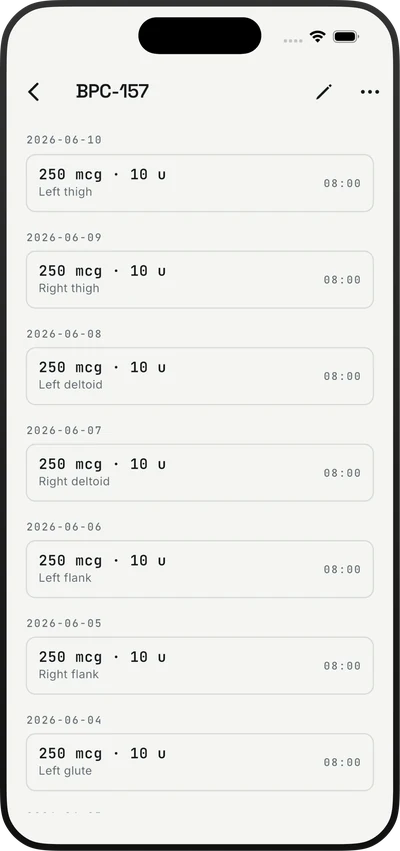
Six months later nobody remembers which vial a dose came from. Storing the concentration with every entry is the unglamorous decision that keeps a history interpretable, and it is what makes an export worth handing to a clinician instead of apologising for.
In the app
The calculator, and the record it feeds.
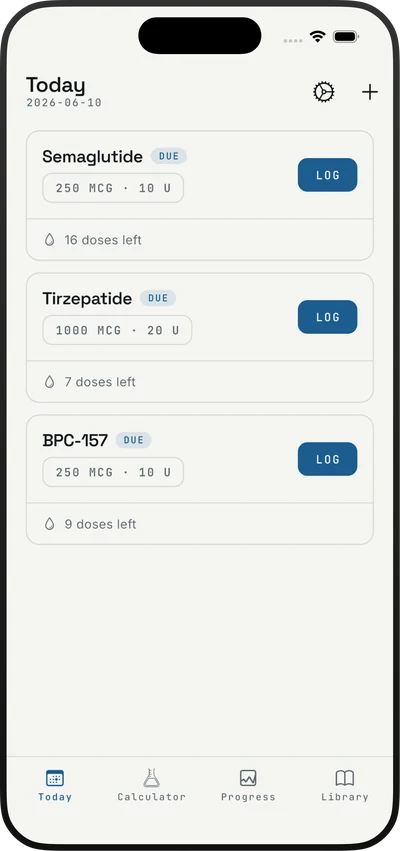
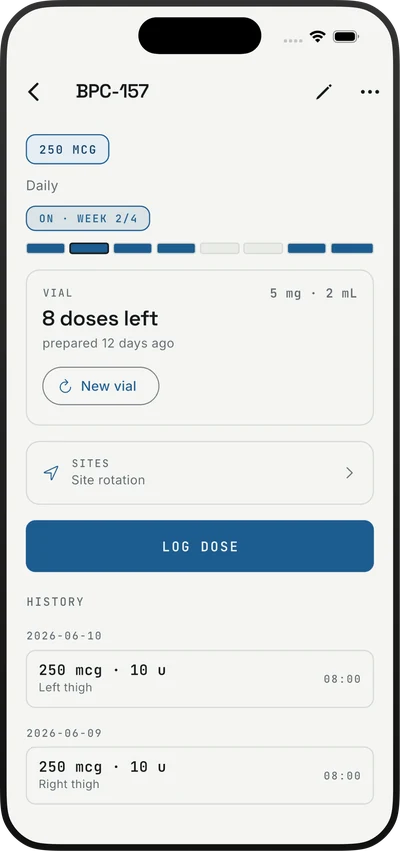
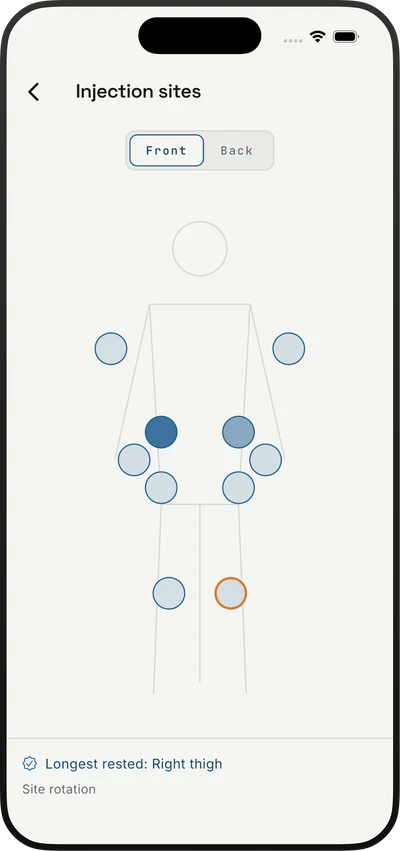
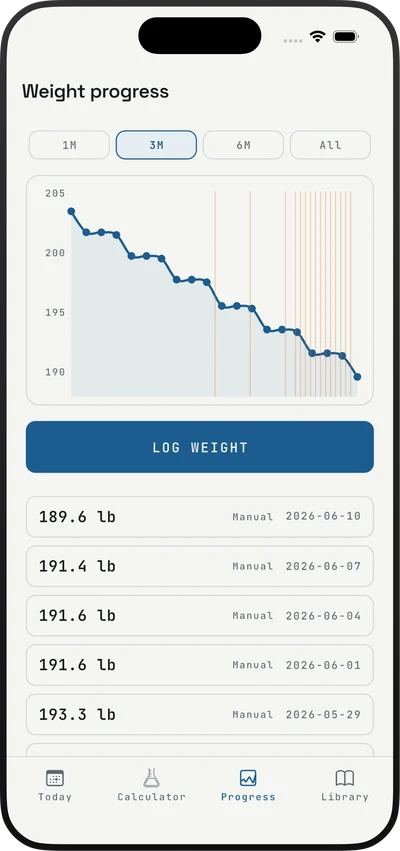
The calculator is the reason people install it. The log is the reason they keep it. Every entry stores what was administered, at what concentration, on which date and at which site, so the history stays readable long after the details have left your memory.
Free, in your browser
Five calculators, no sign-up, nothing transmitted.
The same arithmetic that runs in the app, on the open web. Each one shows its working rather than returning an unexplained number, because a calculator you cannot check is a calculator you should not trust.
Reconstitution calculator
Vial strength and diluent volume to concentration, millilitres and units — with every intermediate number shown.
Open the calculator →Bacteriostatic water calculator
How much diluent to add to reach a concentration you can actually measure on the barrel you own.
Open the calculator →Syringe visualizer
A U-100 barrel drawn to scale, so you can hold your real syringe against the screen and compare.
Open the calculator →mcg to units converter
The conversion nobody can do without a concentration, with the concentration made impossible to ignore.
Open the calculator →Titration planner
Lay out the schedule your prescriber gave you as dates and syringe readings. It plans, it does not prescribe.
Open the calculator →Pricing
The calculator stays free. Pro is for the record-keeping.
Free
- Reconstitution calculator, unlimited
- Dose log with concentration stored per entry
- Vial tracking and doses remaining
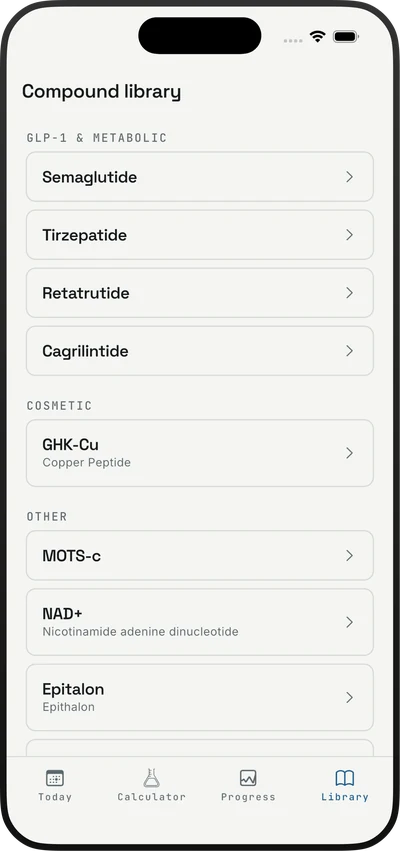
- Bundled compound reference library
Pro
- Dose reminders, cycle-aware
- Cycle planner with phase tracking
- Injection-site map with full rotation history
- Weight progress, synced from Apple Health
Cancel any time. The trial costs nothing.
Questions
Straight answers.
Is Dosyne free?
The reconstitution calculator is free forever, along with the dose log and vial tracking. Pro adds reminders, the cycle planner, the injection-site map history and weight progress with Apple Health — $5.99 a week or $49.99 a year with a 7-day free trial. The calculator is never paywalled, because it is the part people need most often.
Does Dosyne tell me what dose to take?
No, and it never will. Dosyne converts numbers you already have into a syringe reading: vial strength, diluent volume and the amount specified by your prescriber become millilitres and units. What to use, how much and how often is a decision for a licensed prescriber, and no calculator can make it.
What is a unit on an insulin syringe?
On a U-100 syringe, one unit is a volume of 0.01 mL. It is not a quantity of drug. Ten units is 0.10 mL whether the barrel contains insulin, saline or a reconstituted peptide, and how much substance that carries depends entirely on the concentration in the vial. Confusing the two is the single most common error in this subject.
How much bacteriostatic water should I add?
There is no single correct volume. The amount you add sets the concentration, which sets the syringe reading, so the practical approach is to work backwards from a reading you can measure accurately. The free bacteriostatic water calculator on this site does that arithmetic and shows every step.
Does my data leave the phone?
No. There is no account, no login and no server. Your logs, vials and settings are stored on the device, all calculations run locally, and the app has no analytics SDK of any kind. The App Store privacy label says Data Not Collected because that is genuinely true.
Does it work for GLP-1 medications?
The arithmetic is the same for any reconstituted vial, so semaglutide and tirzepatide work exactly like anything else: read the concentration on the vial, enter the amount your prescriber specified, and get the syringe reading. Dosyne also records which dose you took and when, which is what a prescriber uses to decide the next titration step.
Can I keep using it after a vial changes?
Yes, and this is the specific thing most trackers get wrong. Dosyne stores the concentration alongside every logged dose, so a history stays interpretable months later even after the vial strength or the diluent volume changed. A log of milligram numbers with no concentration attached becomes unreadable the moment anything changes.
Is it on Android?
Yes, on Google Play as well as the App Store. The free calculators on this website work in any browser on any device if you would rather not install anything at all.
The Lab
The reference we could not find anywhere else.
Reconstitution arithmetic, syringe graduations, storage chemistry and the honest state of the evidence. Read the whole section.
Peptide tracker app: what it actually needs to do
Peptide tracker app comparison: which apps keep the concentration attached to every logged dose, survive a vial change, and export a history a clinician can read.
Jul 28, 2026Peptide reconstitution mistakes: nine ways to quietly ruin a vial
Peptide reconstitution mistakes can ruin a vial or distort a dose. Learn the failure modes, concentration math, syringe errors, and discard signals.
Jul 26, 2026Subcutaneous injection site rotation that holds up
Subcutaneous injection site rotation protects usable tissue and reduces absorption variability. Learn how to map zones, spot lipohypertrophy, and log sites.
Do the arithmetic once, keep the record forever.
Free on iPhone and Android. No account, no server, nothing leaves your phone.